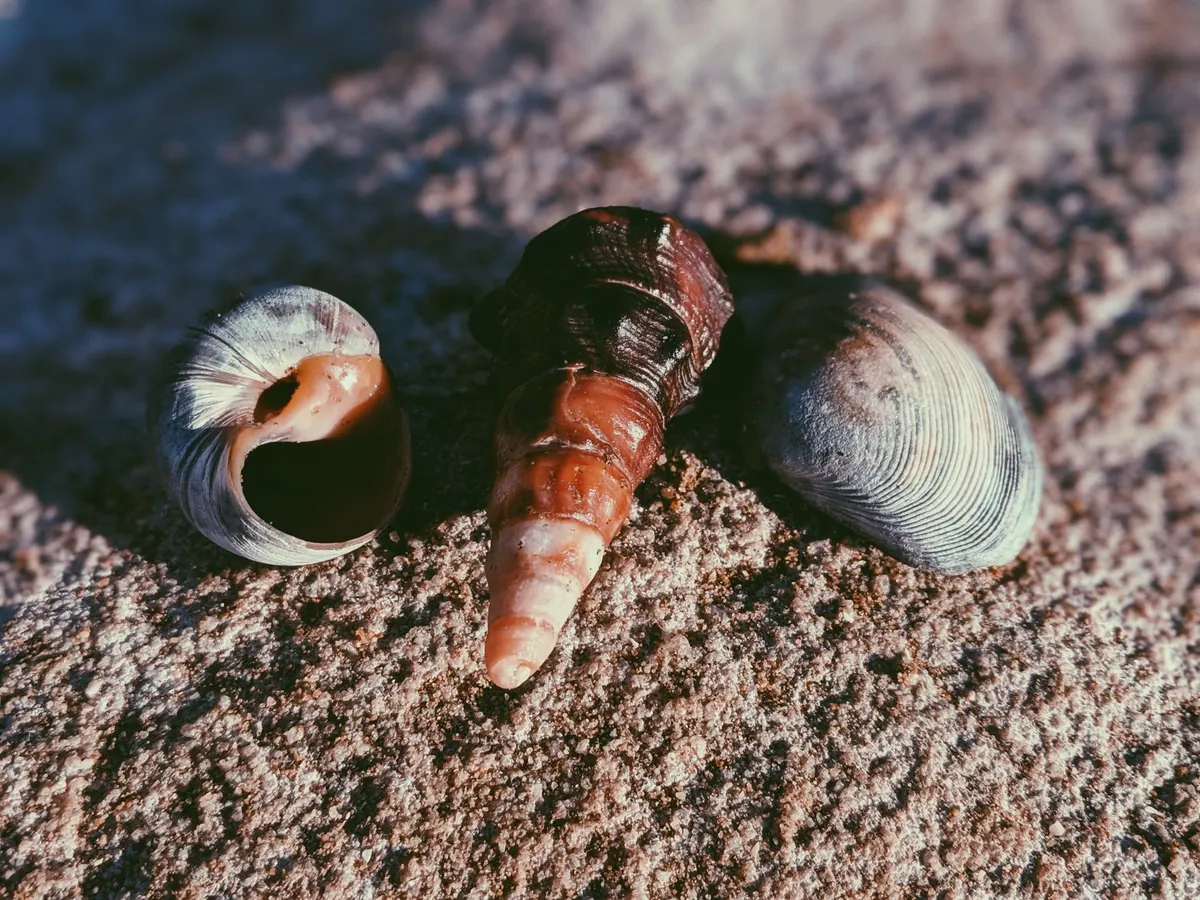
The tide pulls back and the beach turns into a museum with no labels. Half a mile of sand can hold limpets, cockles, whelk egg cases and something pale and oval you'd swear was a fossil. You don't need a marine biology degree to enjoy it — you need a bit of patience, a hand lens and a rough idea of what you're looking at. Here's how to start identifying what you find, and how to do it without taking anything that's still alive.
A shell with an occupant is easy to miss. If it's stuck to a rock, has anything soft showing, feels unusually heavy for its size, smells of the sea at low tide, or moves when you nudge it, put it back exactly where you found it. Limpets clamp down hard; periwinkles and topshells sit in damp crevices; mussels grow in tight clumps on piers and boulders. Whelk and periwinkle shells are also popular hermit crab homes, so a shell with legs is not a shell.
The good news is that the strandline — the ribbon of debris marking the last high tide — is almost entirely empty shells, worn smooth and sun-bleached. That's your hunting ground. Before you pocket anything, check whether the beach is covered by a byelaw or sits inside a protected site such as a nature reserve or marine conservation zone, where collecting may be restricted. If you're unsure, ask the local authority or the site warden, or simply photograph your finds and leave them.
Learn these properly and you'll recognise most of what washes up around the British coast.
Two pairs cause most confusion. Dog whelks and common whelks are both pointed spirals, but a dog whelk is small — seldom more than three centimetres — often with a neat channel around the top of each whorl and a shell that can be white, yellow or striped. A common whelk is a chunky brute that can reach ten centimetres and lays those sponge-like clumps of capsules known as sea wash balls. Periwinkles and topshells look similar too, but topshells are more sharply conical with flatter sides and a pearly inside.
Among the scallops, look at the hinge. The great scallop is larger and more strongly domed; the queen scallop is smaller and flatter with the two little "ears" either side of the hinge differing in size. Slipper limpets are the odd oval shells, curved like a small shoe with a shelf inside, often stacked in piles on top of one another. They're a non-native species and now very common on southern and western shores.
Mermaid's purses are the empty egg cases of sharks, skates and rays. Each species lays a differently shaped one, which makes them genuinely satisfying to identify. Pick one up and you're holding a piece of evidence about what swims off that coast.
If a case is still dark, soft and pliable, or you can see a yolk inside, it may hold a developing embryo — put it back into shallow water or return it to the strandline well below the high water mark. The ones worth keeping are dry, stiff and usually have a small split or hole where the youngster left.
Sightings are worth recording — the Shark Trust runs a national egg case survey that welcomes records from casual beachcombers. Whelk egg cases are a different thing altogether: clusters of small capsules that dry into a honeycomb sponge, sometimes called a sea wash ball.
Cuttlefish bones are the chalky white, oval objects that float in on the tide. They're the internal buoyancy structure of the cuttlefish and make useful, if smelly, food for cage birds. Sea potatoes are something else: the fragile, brown, bristle-marked tests of heart urchins, found on sandy beaches after rough weather. They crush easily, so carry them flat in a tin rather than in a bucket.
Sea glass is simply broken glass tumbled smooth by the sea — green, white and brown are common, blues and reds much rarer. Handle it respectfully; edges can still be sharp. A word of caution on wildlife: never touch jellyfish, including the Portuguese man o' war, and watch where you put bare feet on wet sand, where weever fish bury themselves. If anyone is stung or spiked and feels unwell, seek medical advice.
Choose ten species and learn them thoroughly rather than vaguely recognising a hundred. Keep a plain notebook: date, beach, tide state, wind direction, what you saw. Photograph the underside of shells too — the hinge, aperture and teeth are usually what settle an identification.
Return to the same stretch of coast in winter and summer and you'll notice the strandline changing with the seasons and the prevailing wind. Local coastal and wildlife groups often run walks and shore surveys, which is the quickest way to absorb a hundred small details you'd never get from a book. Wash your hands after handling finds, rinse and dry anything you keep, and take home only what the beach can spare.
Photo: Valeriia Miller / Pexels

British seaside weather can deliver four seasons in one afternoon. Here is a flexible packing list covering layers,...
A month-by-month coastal gardening guide covering shelter, mulching, pruning and planting for colour, with practical...
How to build a calm coastal scheme using blues, sands, greys and whites — chosen for the sea light in your rooms...

Coastal living, nature, and seaside inspiration.
